Article – EHR Adoption Report: The Latest Trends

EHR Adoption Report: The Latest Trends

Some interesting tidbits…

The Office of the National Coordinator (ONC) for Health Information Technology’s most recent data briefs, reporting hospital adoption of EHR technology based on American Hospital Association (AHA) data, indicated the number of nonfederal acute-care hospitals with EHR systems–also known as electronic medical record (EMR) systems–has more than tripled since 2009, increasing from 12.2 percent to 44.4 percent.

Use of electronic active medication lists and clinical decision support rules increased to 87 percent, from 62 percent and 66 percent, respectively. The percentage of hospitals using computerized provider order entry (CPOE) jumped 167 percent, from 27 percent in 2008 to 72 percent in 2012.

The ACP/AmericanEHR study showed user satisfaction fell 12 percent from 2010 to 2012, with the percentage of very dissatisfied clinicians increasing by 10 percent. Thirty-nine percent of physicians would not recommend their EHR to a colleague. The numbers were similar for physicians in a variety of practice settings.

…physicians do not like being forced to use electronic technologies and that EHRs do not measure up to what they are used to in their day-to-day lives, which include iPad apps and smartphones, saying that record systems are fairly rigid with a flat interface.
Article – mHIMSS executives say FDA regulation won’t hold back app innovation

This short Q&A article discusses the role and impact of FDA regulation, as well as the new medical device excise tax.

Some thoughts…

  • Someone explain to me how applications accessed on a tablet or smartphone are so much different than a desktop app being accessed on a netbook on Wifi. A tablet is a computer, typically without a keyboard and mouse. The user input method varies slightly and we have a whole new class of device? I don’t get it. If an application is collecting clinical data (e.g. dermatology photo), it should be subjected to appropriate regulations regardless if the user is using a mobile computer or a full desktop to run the application. This seems to me like a lack of understanding of computing by policy makers.
  • I believe the driving issue are mobile app developers getting into healthcare rather than registered medical device manufacturers getting into building mobile apps. Those familiar FDA regulations (and similar ones in other jurisdictions) generally know the rules. It is the mobile app developers unaware of the FDA regulations that are likely facing the greater challenge (mostly learning the requirements of being a medical device manufacturer). Providing the right guidance to the app developer community could be a growing opportunity for experienced regulatory affairs contractors/consultants.

Too Many, Too Few …Just Right

One thing I have noticed (and was commented on by an esteemed panelist at the SIIM Regional meeting) is the wide disparity of the number of IT and Admin staff working on medical imaging systems among similarly sized facilities. One hospital has 10 FTE, while a peer has 2 FTE. I can’t imagine that there are productivity differences to account for such a variation. I have to think that one is simply doing more work (quality control, systems integration, user support and training, etc.).

This begs the question: how many FTE is the right amount?

I have not seen anyone come up with a ratio of the number of FTE per exam volume amount, modalities, etc.

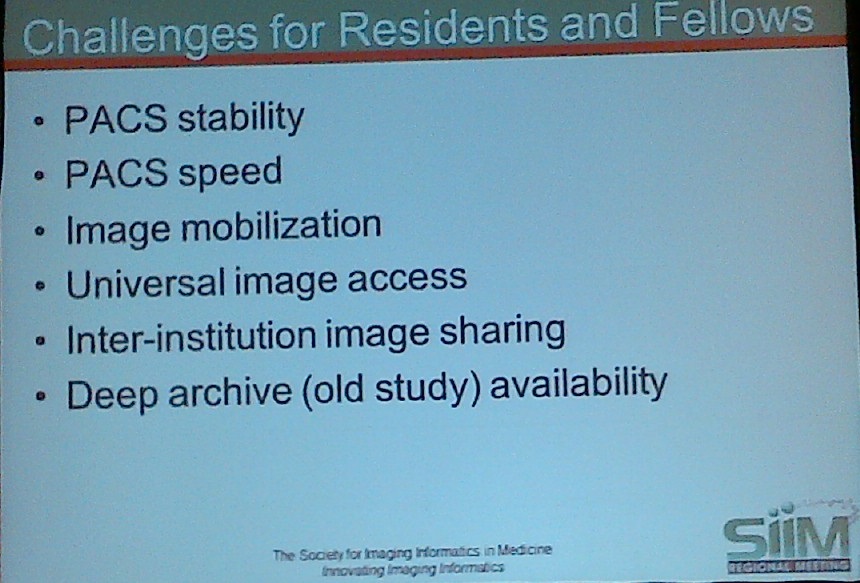
PACS Challenges – A Perspective from the SIIM Regional Meeting

SIIM Reg Meeting Mar-2013 - PACS Challenges

“PACS” is used well beyond radiology; how can they still own it? It is being decomposed into discrete services, but it still has to come together and be fast and reliable (software is only valuable if it is available and responsive when needed).

Integrating patient records (different patient ID domains, order schema, different procedure codes, etc.) is critical to a patient’s imaging record interoperability, whether it is to consolidate records to a shared system (e.g. imaging studies in a VNA), or at access time (on demand cross indexing when viewing studies from different patient ID domains).

For all the pages of must have features that fill a PACS RFP, most people I talk to would trade most of them for a fast PACS that never crashes.

SIIM Regional Meeting in Philly

I am attending the SIIM regional meeting in Philadelphia. Keeping the sword sharp by listening to experts talk about challenges in radiology and informatics. Good turnout. Great to see some friends.

Noted some increasingly commonly reported trends…

  • Funds for PACS expansion, upgrades, and replacements are threatened by the focus on EMR adoption.
  • Enterprise imaging is becoming a focus for informatics professionals; a VNA is the most common place sought to store these images.
  • In addition to the VNA taking the “A” out of PACS, it seems most people are looking to PACS add-ons (“PACS Apps?”) to solve problems over looking for a solution engineered into their PACS. I wonder if this is because of the focus that a smaller vendor can apply to the problem space, or that PACS vendor resources are consumed with managing the installed base, or that they are strategically reducing R&D investment as the PACS market become saturated and radiology revenues decline.

Article from HIMSS: PACS will not remain a self-contained data silo

Have a read (may need an account).

Some thoughts…

  • The shift of the “archive” out of PACS has been well-discussed and is occurring today with the maturation of the VNA market; though these primarily serve PACS.
  • I believe that the next evolution will be a significant advancement in the ease at which a medical imaging record may be discovered and accessed. And these records will be dynamically transformed and provided to the wishes of the consumer (user or application). This will come through new REST-based Web protocols, such as those being defined in DICOM WG-27 and the HL7 FHIR initiative; as well as modern full text search methods.
  • With these new methods the lines between records in DICOM, document, or structured data formats will be blurred and the content much easier to cross-index and normalize.
  • The same evolution (easy to find, access, use) will occur to resources, such modalities and clinical specialists. The freedom I have to find and reserve a flight among dozens of providers within seconds compared to the ability to book an appointment for a CT exam would be laughable, were it not depressing.

Article: Healthcare Imaging Strategies Not Exactly a Snap

An article on enterprise imaging and image sharing that is worth a read.

Some thoughts…

  • Informatics at the time of capture is (very) important, but this doesn’t mean we are back to typing data in–most of what is needed can easily be discovered on demand by a Web service
  • VNA’s are still being considered a component distinct from PACS and the EMR–they should be considered an EMR component, enabling the management of imaging records within the EMR
  • You can question the ROI of including images in the EMR or assess the clinical relevance (both noble goals), but one thing I have learned: EMR users want them there (and you should want to make them happy)
  • People still think we need to move a full copy of the DICOM images around to share; when I share a video on YouTube, I share just a link. The state-of-the-art of medical imaging is at the same level. Only make a copy of the full data if you need to incorporate it into your systems as a new record.
  • Something I have recently observed: regardless of whether including images in an EMR is an optional menu or required core item in MU, if the people interpreting these rules believe they need image access display for referring physicians inside and outside the hospital, they are going expect to be able to put them there.

5 CIOs imagine health IT in 10 years

via Healthcare IT News.

Patterns…

  • Interoperable (HIE) and integrated (EMR) patient records
  • Sensors/monitors (bedside, mobile, home) integrated with health records
  • Shift of risk from payers to providers (providers funded based on outcomes, quality measurements, savings realized–not volume of procedures)