Enterprise Imaging Industry State-of-the-Art

Based on discussions with colleagues and our clients, Enterprise Imaging is becoming an integral part of U.S. Hospital IT Consolidated Clinical Record strategies.

HIMSS-SIIM Enterprise Imaging Workgroup‘s current working definition of Enterprise Imaging is as following:

  • Diagnostic Imaging – Encompassing traditional diagnostic imaging disciplines such as Radiology and Cardiology
  • Procedural Imaging – Including images that are acquired for diagnosis or clinical documentation purposes (such as visible light photos, point-of-care ultrasound)
  • Evidence Imaging – Including images and/or videos that are acquired for clinical documentation purposes (for example, scope videos, computer aided detection)
  • Image-based Clinical Reports – Documentation that includes or entirely consists of images (for example, Pulmonary Functional Test (PFT) report, multi-media pathology report)

Despite the attention from vendors, industry focus, and provider demand, this market space is still in its early stages of development. There are two main reasons: 1) the scope of the problem domain is still being defined; and 2) the vendor community is still working out the best practices and optimal technical approaches.

Moreover, the number of the departments that generate Enterprise Imaging content and that have their own departmental workflows is quite large.

This results in significant confusion on the provider side who are left to navigate a myriad of perspectives expressed by the imaging informatics industry. There are on-going initiatives that are currently working on demystifying the field of Enterprise Imaging. For example, the recent SIIM Webinar delivered by Dr. Towbin from Cincinnati Children’s, provides a very thorough analysis of the problem domain.

In conversations with vendors and providers, we have compiled several observations that might benefit the imaging informatics community.

The Right Approach

In the SIIM 2015 Opening General Session presentation, Don Dennison presented the following slide titled “Enterprise Image Management: Making the Right Choice”
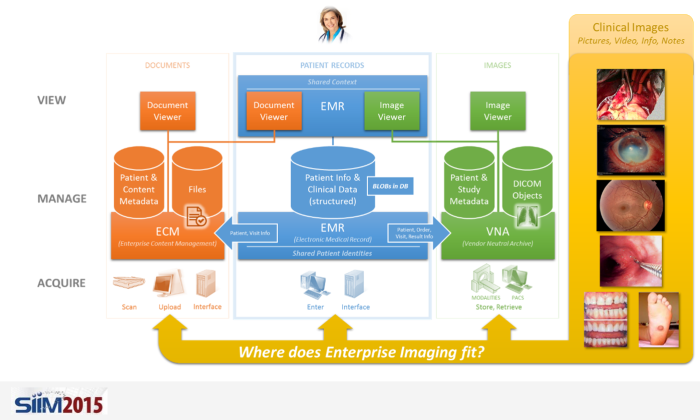
EI

With the various systems in place to manage patient record data, there is often debate as to which enterprise system is best suited to offer Enterprise Imaging services.

At the moment, there is no obvious answer to the question presented by the slide. Besides the technical capabilities of the systems, the provider’s internal IT capabilities, capacity and policies can significantly influence the decision. At some organizations, where the Imaging Informatics Team plays a prominent IT role, the choice could be the VNA, while at others, where the Enterprise IT team takes the lead, the EMR or ECM is often chosen.

The Right Functionality

During RSNA 2015, we conducted a study to identify the state-of-the-art of Enterprise Imaging technology, including methods of acquisition, management, and distribution of non-DICOM images. The following table summarizes our findings.


Image / Video Acquisition
Ability to capture from mobile devices The majority of current vendors opted for native applications to provide better user experience and tighter security controls. Still, image capture is the prevailing capability, with video acquisition capabilities lagging behind. Some vendors offer integration with leading EMRs’ mobile applications.
Ability to capture from visible light cameras The ability to manually (i.e. file browse, drag & drop, etc.) upload both videos and images is a commodity. Automatic ingestion, on other hand, varies significantly from vendor to vendor. Most vendors offer proprietary integration frameworks, but their comprehensiveness and real-life integration experience is very different from one to another.
Ability to capture from different scopes Most of the vendors leverage third party hardware devices to integrate with digital or analog video sources real-time.
Acquisition Workflow
Order-based Workflow DICOM Modality Worklist (DMWL) SCU support, as well as the ability to generate or receive order information, are available in most vendor’s applications.
Context-based launch of the capture application is also a well understood and supported functionality.
Many of the vendors mimic an order-based workflow (i.e. create the Accession Number) for the acquisitions that are not scheduled. The main challenge with this approach is to determine the correct method to feed the created information back to the EMR (e.g. often called an “unsolicited result”, which may not be supported at the site).
Encounter-based Workflow Some vendors, originating from the Diagnostic Imaging space, struggle with native Encounter-based workflow support.
On many occasions, departmental visit/encounter information, supplied in HL7 messages from the EMR, is sufficient to build specific acquisition worklists for different service lines.
Scenarios where information services are not available Most of the vendors offer the ability to manually create patient and procedure information. The difference lies in whether all or just a sub-set of capturing methods (e.g. mobile vs. desktop) support that functionality.
Patient identity management Standards-based methods to discover or receive patient information is widely supported, while the support for proprietary methods to connect to patient information sources varies from vendor to vendor.
Ability to Edit Images/Videos
Editing Tools Most of the vendors rely on an installed Windows OS client application to edit (e.g. crop) acquired images or videos as part of the manual upload process (e.g. drag & drop). Selected vendors also allow static image editing only (i.e. no video) during the mobile capture.
Images An ability to associate different types of metadata (including notes) is supported by the majority of the vendors. Also, basic manipulation of the acquired images such as image deletion, markups and annotation, which are stored as overlay objects associated with the acquired images is common.
Only selected vendors are capable of calibrating images on-the-fly by using recognizable objects of known size embedded in the image.
Videos A flexible and comprehensive ability to associate different types of metadata (including notes and keywords) is supported by the majority of the vendors.
Most of the vendors have very limited (if at all) video editing and capturing capabilities and rely on third party providers.
Viewer
Current state The solutions typically consist of the following viewers:

  • Mobile capture
  • Desktop image/video upload
  • Desktop image/video editor
  • Zero-footprint (ZFP) EMR viewer with very limited, if at all, editing capabilities
Privacy and Security
Current state Most of the vendors offer a range of methods to ensure PHI protection such as:

  • Information deletion/encryption from the device
  • Strong Authentication and Authorization methods
  • Auditing
Reporting
Current state The most prevalent approach is to rely on an external system, such as the EMR or specialty-specific reporting application, to create and manage reports.
Record Management
Current state Most of the vendors opt for managing image and videos in their native format, while converting the content on-the-fly for standards-based communication with external systems.

Conclusion

It seems that Enterprise Imaging is going to rapidly evolve and we are eager to see how our clients, and providers in general, will benefit from these changes.

Working on an Enterprise Imaging project? Leave us a comment with your thoughts, or contact us.

Article – MU No More…Meet MACRA, MIPS and APMs

The death of Meaningful Use (MU) will not be mourned by many physicians.

While the overall program drove adoption of electronic medical record (EMR) systems, which is necessary for information accessibility, the measures required to be reported upon were viewed by many as misguided and not a reflection of the actual practice of medicine.

Also, many of the EMR systems implemented were criticized as being hard to use with limited capabilities to allow information interoperability with other systems.

Regardless of one’s views of MU, CMS is moving on.

With a keen focus on patient outcomes, CMS is looking to new models for reimbursement, such as the Medicare Access and CHIP Reauthorization Act (MACRA) legislation, introduced last year.

CMS is also intent on addressing the lack of interoperable patient record information.

“We’re deadly serious about interoperability. Technology companies that look for ways to practice data blocking in opposition to new regulations will find that it will not be tolerated.”

Andy Slavitt, acting administrator of the Centers for Medicare & Medicaid Services

The MACRA site provides an overview of Merit-Based Incentive Payment System (MIPS) and Alternative Payment Models (APMs), which are sure to be popular acronyms to fill the void created by the decline of the use of MU in discussions.

Here is another article on Slavitt’s comments. And another article by HIMSS.

My previous posts on healthcare payment reform are herehere and here.

Article – First Look at Stage 3: CMS Sticks to Its Guns on APIs, Patient Engagement

Here is a good summary on what is new in Meaningful Use Stage 3 Rules.

This excerpt caught my eye:

As far as timing goes, CMS said it disagrees that the API functionality cannot be implemented successfully by 2018 “as the technology is already in widespread use in other industries and API functions already exist in the health IT industry.”

All of this should be a boon for the FHIR (Fast Healthcare Interoperability Resources) standard development community and the Argonaut Project, working on API-related standards, as well as for the broader community of mobile app and personal health record developers. With barriers to patient access to their data coming down, patients will finally be able to create their own portals, separate from any health system and share that data with whomever they want.

This is good news for everyone.

If we truly want so solve issues that require access to information where and how we need it, we must provide interoperability. This means not only the data needs to available be in a format that is understood and supported by common applications, it means the method of discovering and accessing that data needs to be understood and supported, as well.

FHIR® (clinical data) is built on the right web technologies and design methods, as is DICOMweb™ (imaging data). With these APIs, we can discover and access the necessary patient information and make it available in any care setting we need.

And these APIs will create the foundation of data liquidity to spark an explosion of innovation of applications—including traditional departmental and enterprise ones, but also web and mobile ones.

Without clearly defined, supported and accessible APIs, we (healthcare) had no hope of achieving the kind of system-wide change required. We have no more excuses now.

Article – The Healing Power of Your Own Medical Records

This NYT article tells the story of a very bright young man that took control over has health data and probably saved his own life. Few of us have the knowledge to do what he did, but most would agree that having the choice to access our health data is the right approach.

I suspect that as long as the risk of uninformed patients misusing the information they access and the risk of unauthorized access of protected health information outweigh the demand for access to the information, progress will be limited. How do we balance freedom of information and data liquidity with effective access controls and reasonable assignment of liability?

Previously, I blogged about my thoughts on patient privacy and its use as an excuse for an non-interoperable patient record.

What can Enterprise Imaging Learn from Radiology?

Radiology Information Interoperability for Productivity and Quality

In the early days of Radiology, data entry errors by Radiology Technologists (aka Techs) were common. Their attention was on the patient and the operation of the modality, not the clerical task of typing in data, after all. To address this, something called a DICOM Modality Worklist (aka DMWL) was developed and adopted.

Essentially, this took the textual patient and imaging procedure order information entered into the HIS or RIS (i.e. the order placer), and sent it to some system as an HL7 ORM message (an order). The structured patient/order information was then provided to modalities using the DICOM protocol (because this is the language they speak). DMWL could be provided by the RIS or PACS or some form of broker system that spoke both HL7 and DICOM.

This allowed trained clerical workers (or physicians), combined with software that validated the data entered (where it could), to pass the information to the modality workstation where it could be mapped into DICOM objects, without having to ask Techs to enter this info. The productivity and information quality gains were significant.

It is worth noting that the order provides other value than just eliminating duplicate data entry. It represents a work instruction, and it is used in scheduling and billing. Where image acquisition is not scheduled or billed for, orders are typically not created.

Enter Enterprise Imaging

As we enter the era of Enterprise Imaging, there are lots of lessons that we can learn from the solved problems in areas like Radiology.

For example, when capturing a photo in a Wound Care clinic, it has to be associated with the correct patient (obviously), but there is likely other pertinent info that should be captured, such as the anatomical region imaged and any observations by the physician.

In Enterprise Imaging, orders are often not placed. In many areas, the imaging is often not the primary task, but one that used to support clinical work.

If orders are not placed, how can we at least provide the benefit of passing textual patient data to the image capture device or application to reliably associate patient (and perhaps encounter or procedure) data?

Even if orders are placed, most of the devices and applications used in Enterprise Imaging cannot accept an HL7 message and do not speak DICOM. Some form of broker would likely be required yet again.

Enterprise Information Interoperability for Enterprise Image Capture

One hope that we have is the adoption of the new HL7 FHIR standard. Based on REST-based API design methods, it is much easier to integrate with different devices (especially mobile devices) than HL7 v2.x messaging and DICOM interfaces are. Other methods used are to generate a URL from the EMR, with all the info provided in parameters, that launches the image capture application/device in context. Another method is to use HL7 messaging to populate the VNA database with patient, encounter and order/procedure information (essentially a copy of what the EMR has), and use a tool or API (perhaps the DICOMweb™ Query API, QIDO-RS) to query this system to get the necessary information.

Don’t Forget the Metadata and Supporting Information

This still leaves the issue of how to reliably and consistently capture the information that goes with the image(s)—notes, anatomy info, findings, technical exam info, observations, etc. In DICOM, when this type of information is needed, a SOP Class is defined. The header of the SOP Class object specifies where all this metadata should go. This is one of the primary principles of interoperability: a defined format and data scheme, with a clear and shared meaning.

Assuming that not all Enterprise Images will be generated in, or converted into, DICOM format, the definition of the metadata schema may be left to be defined by the implementing vendor.

In addition to the clinical and technical data, sooner or later, someone is going to be looking for operational data for use in analytics and process improvement, so it will need to be captured (on some level of detail), as well.

Consistent Terms

And, even when we have a common schema, if the terms used within the scheme are not consistent, we end up spending an enormous amount of time doing mappings or integrating terminology services (and even then, never fully addressing all cases).

To Acquire or Not to Acquire

If we think about Enterprise Imaging that is not “ordered”, what triggers the acquisition of an Enterprise Image? Is it up to the clinic or individual care provider to make the judgement? Should a published set of best practices define this? Would the EMR have logic, based on the patient’s condition or care pathway, to prompt or force the user to acquire and store the image(s)?

Enterprise Imaging Acquisition Protocols Needed?

If we consider the different ways that images can be captured (still, video), the subject in frame (cropping, zooming), lighting, etc., and the ability to capture a single image or a set of images, do we also need some form of a book of protocols to guide the person acquiring the images? Should certain images contain a ruler (or object of known size) to allow the image to be calibrated for measurements?

The Cost of Doing Nothing

If we consider the impact of not having methods to avoid data entry errors, or not having a common schema, not having common terms, and not even having a common communication protocol or best practices for acquisition workflows, what hope does Enterprise Imaging have?

Even with options for all these things, imaging and information devices are still struggling to be interoperable with departmental and enterprise applications, as described in this Healthcare IT News article, “Nurses blame interoperability woes for medical errors”.

The Future is Now(ish)

This is why the mission and output of the joint HIMSS-SIIM Enterprise Imaging workgroup (charter in PDF here) is so important. The space needs to be better defined, with acquisition workflow practices, data formats, schemas, terms, and protocols outlined.

If we simply try to copy what is done in Radiology into Enterprise Imaging, it will create too much of a burden on the people asked to capture these images, and they won’t do it, frankly. Unlike the reimbursement in Radiology, they often have little incentive to spend the extra time to capture, index and upload images to the EMR when they are focused on the patient.

But, if we ignore the benefits that come with the controls and methods we have developed and matured over the years in Radiology, we risk having to re-learn all the same lessons again. And that would be very sad (and expensive, and wasteful, and unsafe…).

Add on top of all this the increasing need to share this data across different enterprises for continuity of care and the importance of interoperable data portability/liquidity is critical.

The fundamental healthcare informatics knowledge and business analysis skills developed by imaging informatics professionals, through on-the-job experience and membership in educational/research societies like SIIM, will be important in determining the right mix of proven concepts that apply, and new methods and innovations. Without a supply of talent to foster the change, nothing will change.

In Conclusion…

When dealing with such an undefined space, people often relish the idea of “doing it right this time”. I would urge anyone involved in this space to reflect on what has been accomplished in mature fields like Radiology, as there are a lot of “right things” that we may be taking for granted. With a little modernization, we can still get continued value out of what we have already achieved.

Article – SIIM: Experiment in web technologies points to future of health IT

Here is an article summarizing the way Cleveland Clinic is using REST-based APIs to solve real problems in their institution. Taken from a talk given by Mat Coolidge at the SIIM 2014 Annual Meeting.

Article – SIIM Hackathon gives DICOMweb a coming-out party

Check out this article in Radiology Business Journal on the recently concluded Hackathon at the SIIM 2014 Annual Meeting in Long Beach, California.

Here are my other observations on SIIM 2014, in case you missed it.

New JDI Article Published – Informatics Challenges—Lossy Compression in Medical Imaging

An article I co-authored with Kinson Ho on the implications on informatics and information management when applying lossy compression to medical images in DICOM has been published. Check it out here.

It also explores whether wavelet-based compression (e.g. JPEG2000) still provides the value that it once promised. A comparison of different approaches to preserve system and network resources is included.

It is available in Journal of Digital Imaging.

Webinar – Separating PACS Servers from VNA…and then Connecting Them

I will be doing a Webinar on the differences between your PACS server and a VNA, as well as what to look for in a VNA (and in your PACS when connecting it to a VNA), on May 20, 2014 at 1 pm ET. We will have time for some Q&A, so it should be a good session.

Registration is free. Sign up here.

Article – The time is now for deconstructed PACS

Here is another article (on Aunt Minnie; you likely need an account to access, but it’s free) predicting the deconstruction of PACS (and workflow management systems, like RIS). This mirrors many of the same predictions made in the article titled PACS 2018: An Autopsy, published in JDI recently.

The author’s observations on the lack of recent innovation in PACS is likely attributable to the saturation of PACS in mature markets. Would you invest the same amount in R&D on PACS in today’s environment as you would before the PACS “gold rush” of the mid-2000’s? I touched on this in a blog post a year ago after attending the SIIM 2013 Annual Meeting.