SIIM 2016: Where’s Don

SIIM2016

SIIM 2016 is almost here. If you are attending this year’s Annual Meeting, you may find these sessions that I am chairing of interest.

Developing an Imaging Record Quality Policy
Thursday, June 30 | 1:15 pm – 2:45 pm
Portland Ballroom 256

Strategies and Tactics for Capturing and Sharing Images
Friday, July 1 | 8:00 am – 9:30 am
Portland Ballroom 256

Strategies for Dealing with Patient Identities in a Consolidated Enterprise
Friday, July 1 | 1:15 pm – 2:45 pm
Portland Ballroom 256

Basically, just park yourself in Portland Ballroom 256 and I will come to you.

I will also be participating in the:

Hackathon Project Showcase (#SIIMHacks)
Friday, July 1 | 9:45 am – 10:45 am | Portland Ballroom 254

I look forward to catching up with some old friends and making some new ones over some craft beer!

Medical Imaging Informatics and Teleradiology (MIIT) 2016 Conference

MIIT2016

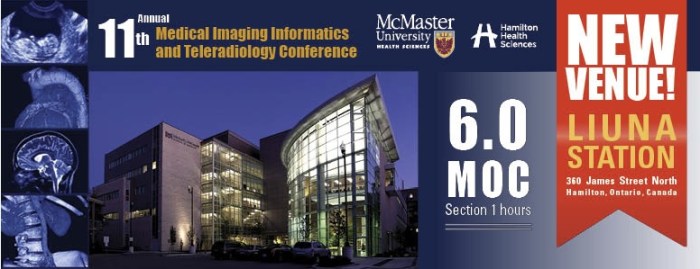
Genady Knizhnik (@genady_knizhnik) and I (@donkdennison) will be speaking at the 11th annual MIIT conference on Friday June 17th, 2016 in Hamilton, ON, Canada (Liuna Station, 360 James Street).

I am moderating a panel discussion in a session titled “Longitudinal Patient Imaging Record in a DIR” and presenting a talk on “Breast Tomosynthesis: Impact on IT Systems”.

Genady is presenting on “PACS Consolidation and Imaging Record Quality Policies”.

More information, including the complete program, is available here.

Register to attend here.

Article: The biggest problem in health care today

This article, inflammatory headline aside, is spot on.

In what other industry are consumers provided less information about the cost of a product or service until after purchase?

Price transparency is the first step in allowing consumers to choose. And choice means market forces drive down costs and force providers to focus on efficiency (or go broke trying).

For more reading on healthcare financials, including Radiology reimbursement, read my past blog posts here, here, here, and here.

Article – Hospital Hookups: Implications for Imaging IT

This article interviews several people in the trenches, and on the front lines, of imaging IT planning, integration and management in today’s Consolidated Enterprise.

Critical to success are:

  • Imaging and clinical informatics knowledge (how to get all those MRNs to link, how to manage orders and results across facilities)
  • Solution flexibility/scalability (having systems that can expand, as needed, at reasonable cost…even temporarily during a data migration)
  • Viable financial models (shared cost allocations based on volumes)
  • Policy development (for assigning user permissions and setting data quality and retention targets)
  • Human resource planning (what roles and skills are needed post-consolidation)
  • Partnerships with suppliers (to ensure that system expansion and data consolidation will succeed at predictable costs)

Organizations that prepare for consolidation and invest effort in these areas will survive—and even thrive—in the never ending healthcare provider merger and acquisition race.

Article – Predictions for 2016

In case you missed it, here is an article on AuntMinnie predicting changes to the medical imaging universe in 2016. It is on multiple pages, so be sure to check out pages 2 and 3.

Article – MU No More…Meet MACRA, MIPS and APMs

The death of Meaningful Use (MU) will not be mourned by many physicians.

While the overall program drove adoption of electronic medical record (EMR) systems, which is necessary for information accessibility, the measures required to be reported upon were viewed by many as misguided and not a reflection of the actual practice of medicine.

Also, many of the EMR systems implemented were criticized as being hard to use with limited capabilities to allow information interoperability with other systems.

Regardless of one’s views of MU, CMS is moving on.

With a keen focus on patient outcomes, CMS is looking to new models for reimbursement, such as the Medicare Access and CHIP Reauthorization Act (MACRA) legislation, introduced last year.

CMS is also intent on addressing the lack of interoperable patient record information.

“We’re deadly serious about interoperability. Technology companies that look for ways to practice data blocking in opposition to new regulations will find that it will not be tolerated.”

Andy Slavitt, acting administrator of the Centers for Medicare & Medicaid Services

The MACRA site provides an overview of Merit-Based Incentive Payment System (MIPS) and Alternative Payment Models (APMs), which are sure to be popular acronyms to fill the void created by the decline of the use of MU in discussions.

Here is another article on Slavitt’s comments. And another article by HIMSS.

My previous posts on healthcare payment reform are herehere and here.

Article: Major Insurance Company will no longer cover Breast Tomosynthesis Exams

Per this article, citing lack of clinical evidence and radiation dose concerns, Cigna will no longer cover Breast Tomosynthesis exams, which generate 3D image sets, as of 15-Feb-2016.

Digital Breast Tomosynthesis (DBT) exams are often praised for their superior ability to provide effective imaging when diagnosing women with dense breasts.

Somewhat of a challenge for IT systems and staff due to the significant size of their data sets compared to the traditional 2D mammogram exams, adoption of DBT modalities has been rapid lately due to the generally accepted diagnostic benefits.

I can’t imagine that this lack of coverage will last.

For those wanting a description of the different between 2D (Mammogram) and 3D (Tomosynthesis) breast imaging, this article provides an overview in plain language.

Here is an RSNA article on the state-of-the-art for Breast Tomosynthesis.

And here is an article on the merits of Breast Tomosynthesis over traditional Mammography for detecting cancer.

And another on reducing recall rates.

ACR: CMS Delays Clinical Decision Support (CDS) Implementation Requirement

ACR post (30-Oct-2015) is here.

Highlight…

…CMS states that they anticipate including further discussion and adopting policies regarding claims-based reporting requirements in the CY 2017 and CY 2018 rulemaking cycles. Therefore, they do not intend to require that ordering professionals meet this requirement by January 1, 2017

Article – First Look at Stage 3: CMS Sticks to Its Guns on APIs, Patient Engagement

Here is a good summary on what is new in Meaningful Use Stage 3 Rules.

This excerpt caught my eye:

As far as timing goes, CMS said it disagrees that the API functionality cannot be implemented successfully by 2018 “as the technology is already in widespread use in other industries and API functions already exist in the health IT industry.”

All of this should be a boon for the FHIR (Fast Healthcare Interoperability Resources) standard development community and the Argonaut Project, working on API-related standards, as well as for the broader community of mobile app and personal health record developers. With barriers to patient access to their data coming down, patients will finally be able to create their own portals, separate from any health system and share that data with whomever they want.

This is good news for everyone.

If we truly want so solve issues that require access to information where and how we need it, we must provide interoperability. This means not only the data needs to available be in a format that is understood and supported by common applications, it means the method of discovering and accessing that data needs to be understood and supported, as well.

FHIR® (clinical data) is built on the right web technologies and design methods, as is DICOMweb™ (imaging data). With these APIs, we can discover and access the necessary patient information and make it available in any care setting we need.

And these APIs will create the foundation of data liquidity to spark an explosion of innovation of applications—including traditional departmental and enterprise ones, but also web and mobile ones.

Without clearly defined, supported and accessible APIs, we (healthcare) had no hope of achieving the kind of system-wide change required. We have no more excuses now.