Enterprise Imaging – New HIMSS-SIIM Workgroup

The discussion of so called Enterprise Imaging is a hot topic. So I was very excited to read about the newly announced joint workgroup between HIMSS and SIIM. I believe it holds a lot of promise.

In my experience, there is no lack of technical solutions for capturing, managing, discovering, accessing and viewing enterprise images and related information. The challenge is discovering and sharing the knowledge on best practices of how to put it all together and how to operate the systems that manage this information.

Like diagnostic imaging exams, enterprise images are part of the patient’s medical record, so understanding how they should best be incorporated into the EMR is very important. And this is not just a technical discussion, there are lots of issues around policies and governance of the data that organizations—not their vendors—have to get a handle on.

This is why this workgroup is so important. HIMSS knows all about EMR solutions, and SIIM knows imaging informatics. A perfect marriage.

Creating Practical Value in Practice (of Radiology)

There is a lot written these days about the shift from volume-based to value-based in Radiology (and other medical specialties).

The thing is: volume is real easy to measure. And what gets measured, gets managed.

So, how do we measure value?

One can measure the time it takes to complete the report, sign it, and make it available to physicians and other members of the care team. Radiology practitioners call this Turnaround Time (or TAT). This is pretty easy to do.

We could try to measure whether the report is correct. In other words, is what the Radiologist concludes actually what is wrong (or not wrong) with the patient? This can be harder to measure, as it may take a lot of work to correlate many different data points, or a lengthy period of time for proof to be found.

There are a couple of activities that Radiologists, and other people working in the department, can do to improve the perceived value of Radiology.

In this article, a number of suggestions are made as to how to increase the visibility of Radiologists, as well as improve relationships and trust among other physicians and even patients.

And this WSJ article focuses on simply improving the clarity of the report by improving the language and writing skills of Radiologist. Seems obvious as to the value this would provide, when you read it, but how many Radiologists routinely attend training on how to communicate better?

While improving how Radiologists interact with the outside world—whether through better interactions or better writing—will help the Radiologist’s career, one would hope that it would also improve care. Better communication certainly couldn’t hurt.

Article – Who is the better radiologist? Hint, it’s not that easy.

I really enjoyed this article. It gets into the specifics of what we could mean by quality of Radiology reading.

I think it gets to the crux of the problem in any domain when quality is desired—a trade off is necessary. It may be cost, or it may be the experience of the user, but it will be somewhere.

Let’s use a similar evaluation in software development.

Coders that are fast are lauded as innovative and bright and creative, until their barely-tested and unscalable application fails in operations, or a security hole results in a data breach. These folks are often called “hackers” (but generally in a positive way).

The more thorough developer is criticized for taking too long and keeping the application in the lab (instead of the “real world”) for too long. They spend significantly more time in the design and testing and documentation areas, so to outsiders, they are slow. Their products take more time (missing some early opportunities seized by hackers), but the applications are much more reliable and supportable in operations. They are professional software developers.

As someone that has managed R&D teams before, you always want both behaviors (and results), but as the article posits, you often cannot have both. You certainly shouldn’t expect to get both.

I often say: Decisions are easy (I decide I want innovation and reliability, and I want it fast), but Choices are hard. I value people that can make choices, and live with them, much more than so called “decision makers”.

Article – SIIM: Experiment in web technologies points to future of health IT

Here is an article summarizing the way Cleveland Clinic is using REST-based APIs to solve real problems in their institution. Taken from a talk given by Mat Coolidge at the SIIM 2014 Annual Meeting.

My First Year as a Consultant – What I have Learned

It has now been over a year since I became a consultant. I have learned many, many things and met some amazing people. I thought I would share some of the things that I have learned.

What was the hardest part of becoming a Consultant?

In past roles, I had direct reports and responsibilities of deliverables and operations. I had authority to make decisions, within my defined scope of control. So, I would make decisions, and instruct people to act. As a consultant, you provide recommendations. You use words like “I have observed…” and “According to my evaluation…” and “It is my recommendation…”. It was not really all that hard to make the shift, but changing any habit takes work.

To be honest, becoming a consultant was never a dream of mine. What attracted me to it was the variety of interactions and the opportunity to work on interesting projects. And getting to choose who I worked with. I have been really lucky to work with some great people at my clients, so I am enjoying it quite a bit.

Why Hire a Consultant?

I have found three main reasons people engage a consultant.

Capability

They lack some important skill set in their organization for some short term project. An example is preparing and managing an effective RFP process.

Capacity

Staff is too busy with the day-to-day operations to take on the work of an additional project.

Neutrality

There is a perception of bias among some stakeholders and they need an independent analysis and recommendation.

My Advice

Clients come to me with a wide variety of problems, but my overarching advice is usually the same. You need 3 things: To know (honestly and accurately) where you are; To know where you want/need to be, and; The right amount of talent to get there.

The first item can often be the hardest as our perceptions can skew our reality. The second requires some vision and input and collaboration from lots of viewpoints. The last sounds hard, but it is actually the easiest of the three. You just need the will to seek the talent and to commit the resources to getting it. If the first two steps are done right, the necessity of investing the resources is usually pretty obvious.

The first step to change is admitting that you can’t stay where you are.

Imaging Informatics Knowledge

I have found that there are a number of people that are skilled in HL7 integration (though still not enough to complete all the interfaces needed fast enough), but the level of knowledge in DICOM and IHE is less than I expected. A lot of problems can be solved if one understands the purpose of the information models and transactions that DICOM and IHE have built. The importance of ongoing learning in this area, such as by being a SIIM member and getting involved in that community, is more important than ever.

What is the best PACS (or VNA, or Enterprise Viewer, or other product)?

I get asked this all the time. The answer is always “it depends”. And, I am not trying to use consultant-speak, but it really depends on what you are try to achieve. If there was a one “best” vehicle for everyone, we would all be driving (or flying) it. Different products have their strengths and weaknesses. If you know your business goals, you can define requirements, and then assess the product (and vendor) as to the fit to your needs. Coming up with methods to verify vendor claims, and validate that the value claimed will be realized in your environment, is another important step in the process. The key is designing the right level of “test” (which will have a cost) for the level of risk that the capability represents.

In Closing

I actually learned a lot more than what I listed here, and am happy to share everything I ever learn …with my clients. 🙂 I will post a similar summary after Year Two and see what wisdom another year brings.

Article – CDC on EHR errors: Enough’s enough

In this article, the CDC has issued a warning on the issues of user interface design when presenting patient information in EHRs.

As the examples in the article illustrate, having information in digital form is not enough. It needs to be presented in an effective way to ensure comprehension. After the current wave of information digitization and consolidation (moving information from disparate, departmental clinical information systems into a single large enterprise system), the next wave of effort needs to be on privacy/security, accessibility/reliability, and usability, or the incredibly high potential gains will not be realized.

Users need to trust the system, it needs to be there when they need it (wherever that is), and they have to want to use it.

P.S. Here is an infographic on EHR adoption.

Article – Communities vs. Networks

I highly recommend that you read this very well-written article on the differences between Communities and Networks.

Upon reading, I immediately identified the networks in my life, and the true communities.

I have lamented the erosion of communities to make room for networks in my own life. And I (try to) make genuine efforts to keep my true communities together, but it is not always easy and too often people fail to see the purpose or value.

The Value of Hackathons in Healthcare

Having participated in the inaugural SIIM 2014 Hackathon, I can appreciate the diverse expectations that participants have. Some think of these events as a way to learn and experiment, others a competition. Some prefer to work as a team, others alone. Some are interested in integrating existing systems and data in new ways, while others want to invent something completely new.

In any case, I found this article insightful. It explores why the concept of “hacking” is so prevalent in healthcare, and also touches on why new “apps” often struggle to make it past the hackathon stage. It even posits that a hackathon can replace the traditional RFP procurement process for identifying and selecting innovative solutions.

Revenue Revolution in Radiology

I have been reading a lot recently about trends in healthcare and imaging around costs and revenues. There seems to be a perfect storm of changes in the market that will have a fundamental impact on diagnostic imaging service providers. I find this topic interesting because, unless you understand how the money is moving, you won’t understand why things are happening. Here is a summary of what I have discovered.

Medicare Reimbursement Cuts

This one is obvious. If you lower the amount of money paid for something, your revenues will go down (unless volume goes up proportionally). Here is an infographic from MITA on the cuts made since 2006.

Fewer Medical Imaging Exams being Ordered

Here is an article from MITA on the decline of the total number of CT exams being done in the U.S. Here is another one citing data published by the American College of Radiology (ACR). It states: “…physicians are calling for less, not more, imaging tests.” This shows a measurable reduction in the volume of exams performed in the U.S. And here is an article indicating a steady decrease in imaging studies being ordered for patients in the ED, following a steady increase up to 2007.

Image Sharing

The sharing of patients’ clinical records across facilities is a key part of Accountable Care, and is generally a good thing for patient care. So is sharing imaging records. With reliable options now available on the market, sites within a local referral area are rapidly launching or signing up to services to share images. The clinical benefits of comparing new imaging exams with priors are well understood, but this practice will often result in avoiding the need to perform a repeat exam. This benefits the patient (less radiation and anxiety and delay), and the operations of the receiving organization (less schedule disruption, less costs due to CD importation). The other impact, of course, is that the receiving organization loses some revenue from that avoided repeat exam. This will result in a reduction in volume of exams performed.

Adoption of Clinical Decision Support

Starting on January 1, 2017, imaging exams will require the use of Clinical Decision Support (CDS) to ensure that physicians are following Appropriate Use Criteria (AUC). In addition to clinical evidence, factors such as relative radiation level and cost of the exam are used to determine what is appropriate. All things being equal, the lower cost exam is likely to be recommended. The adoption of CDS may result in a reduction in volume of exams performed, or a recommendation to a lower cost (profit) exam.

Preauthorization Requirements

In some insurance plans, preauthorization is required before certain exam types can be ordered (even when CDS is used, in some cases). This may require a consultation with a radiologist or Radiology Benefits Management (RBM) company. Here is an article from 2011 on the use of preauthorization and CDS. The larger the burden on the ordering physician, the less likely they are to order the exam, which may result in a reduction in volume of exams performed, or a recommendation to a lower cost (profit) exam.

Patient Steerage

Last year, I did a blog post on an article on the trend of “patient steerage”. The original article is here. Essentially, patient steerage is when a payer incents a patient to use a provider that offers the imaging service at a lower cost. If a service provider is not price competitive, this will result in a reduction in volume of exams performed.

The Castlight Effect

This company received a lot of attention because of the size of its IPO, but it is also notable for what they actually do. As this article explains, they provide healthcare provider cost information for a range of healthcare services to employee health plans. The intent being that, given the choice, consumers will choose lower cost options. This is very likely to happen when the patient has a significant co-pay (e.g. 20%) and they will personally benefit from lower cost options. If a service provider is not price competitive, this will result in a reduction in volume of exams performed.

Wait, but what about Quality?

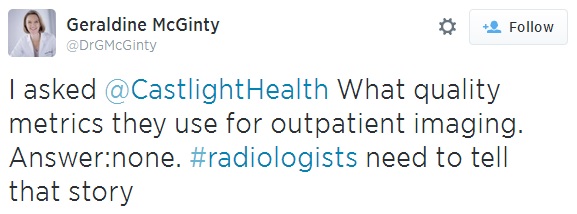
With all the talk about the shift of reimbursement from volume of procedures to quality or outcomes, I found this tweet on Castlight interesting… Castlight Tweet If we shift away from volume incentives/payment, reduce the prices paid (through policy or competition), but don’t recognize quality, the service of diagnostic imaging has been commoditized, and I don’t think that this will benefit patients, in the end.
Consolidation

I have heard a couple of opinions that believe that the strong trend of consolidation among healthcare providers will allow the largest of providers to dictate terms and pricing to payers. As it was explained to me, it works like this: The big, well-known healthcare provider, which has bought up many of the facilities in the area, tells the insurance payers, ‘If you don’t give me preferential pricing for my services, I won’t accept your insurance plan at my facilities’. If the healthcare provider is big enough and well respected, the insurance provider will have a tough time selling insurance plans to companies and individuals when the buyer learns that they can’t go to the big provider. This is called leverage. If this is true (and I think that it is), this will result in isolated areas of reimbursement stabilization or even increases. Here is an article talking about what the impact of provider consolidation means to private payers. It cites a steady increase in the number of physicians becoming employees of hospitals (vs. independent private practices)…

“…the number of doctors employed by hospitals increased to over 120,000 from 80,000 between 2003 and 2011. About 13 percent of all doctors are now employed directly by hospitals.”

A Necessary Change in Revenue Cycle Management Systems

Here is an article on the need for an overhaul of Revenue Cycle Management (RCM) systems in the U.S. It includes some stats on administration costs per transaction (compared to financial services transactions) and consolidation trends, as well as the value of analytics. Some excerpts…

“…the number of hospitals per integrated delivery system took a big jump last year from 6.4 to 7.1…”

“…the physicians who go into practice do not want to be entrepreneurs as much as they used to. When 52 or 53 percent of residents today become employees of integrated delivery systems, it tells you that the whole market has changed.”

Using Analytics to Maximize Revenues

Here is an article on using analytics and their reports to optimize financial operations.

So, what do you think?

P.S. Here is an interview that goes into the details of payer vs. provider, along with a case for more bundled payments. And here is a blog post that goes into more detail on bundled payments, including the shift from retrospective to prospective bundles.

P.P.S. Here is an article explaining the difference between charges and costs.

P.P.P.S. Here is a notice of rule changes proposed by CMS on the method by how physicians fees will be determined. “…we are updating our practice expense inputs for x-ray services to reflect that x-rays are currently done digitally rather than with analog film.”

P.P.P.P.S. Here is an article on a study on the disparity of costs for a Mammogram in the L.A. area. $60 to $254 for self-pay, with a bill of $694 to the insurance company for the same procedure elsewhere. 30% of Mammograms in the study were self-pay.

P.P.P.P.P.S Here is an article, with a nice infographic, on 5 common medical practice denials and remedies. Spoiler alert: Radiology made the Top 5 list of unexpected denials.

P.P.P.P.P.P.S Here is an infographic on the declining employment demand and income of Radiologists by a medical recruitment firm.

Report – Second Annual Practice Profitability Index: 2014 Edition

This report is well-written (in plain language) and is worth a read. While it does not specifically refer to medical imaging practices, the trends are consistent.

My clients are certainly facing similar challenges, especially declining (or changing) reimbursement, changes to adopt ICD-10, and “ripping and replacing” systems. The shift from independent private radiology practices is also shifting to very large groups (consolidation) or hospital employment.

Second Annual Practice Profitability Index - 2014 Edition