Article – Corporate Acquisitions of Startups: Why Do They Fail?

This is a great article. With the rampant acquisition of smaller companies by larger ones that is common in the healthcare IT industry, and the inevitable slowing or death of product innovation and organizational momentum when they merge (read as: are absorbed), it is very useful to know why this happens.

On a related note, if you are interested in start-ups vs. established corporate vendors, check out my article on Where to Build It?.

NEW: Publications and Tools Page

I have created a new page on my Web site to make my content easier to find. I have a number of articles, eBooks and interactive tools available now, or in development.

Check it out here, or look for the page on the menu above.

Webinar – Separating PACS Servers from VNA…and then Connecting Them

I will be doing a Webinar on the differences between your PACS server and a VNA, as well as what to look for in a VNA (and in your PACS when connecting it to a VNA), on May 20, 2014 at 1 pm ET. We will have time for some Q&A, so it should be a good session.

Registration is free. Sign up here.

Article – The time is now for deconstructed PACS

Here is another article (on Aunt Minnie; you likely need an account to access, but it’s free) predicting the deconstruction of PACS (and workflow management systems, like RIS). This mirrors many of the same predictions made in the article titled PACS 2018: An Autopsy, published in JDI recently.

The author’s observations on the lack of recent innovation in PACS is likely attributable to the saturation of PACS in mature markets. Would you invest the same amount in R&D on PACS in today’s environment as you would before the PACS “gold rush” of the mid-2000’s? I touched on this in a blog post a year ago after attending the SIIM 2013 Annual Meeting.

Favorite Blog Posts of 2013

As the first calendar year of my blog draw to a close, I thought I would compile a list of my favorite blog posts from 2013. I hope everyone has a safe, happy, healthy and prosperous New Year.

  1. 100th Blog Post: What I know about Software Development and Crisis Management
  2. The rise of the mobile-only user …and how this helps the underpriviliged
  3. Review of Stage 2 Meaningful Use Test Procedure for Image Results …and other MU tests
  4. Quebec EHR …the difference 2 years makes
  5. Video – Empathy: The Human Connection to Patient Care
  6. Designing for the ‘Public’ and the ‘Pros’
  7. Articles on Mobile Health Applications and FDA Regulation
  8. Plug-ins vs. APIs
  9. Article from HIMSS: PACS will not remain a self-contained data silo
  10. Blog posts on SIIM Web site (Part 1 and Part 2)

JDI Article Published – PACS 2018: An Autopsy

An article I submitted to the Journal of Digital Imaging has been published electronically.

Told from the year 2018, it looks back at the market and technical forces that results in the deconstruction of PACS (and RIS) as we know it.

Check it out and let me know what you think.

How Long Before a Computer Writes the Radiology Report?

I play Fantasy Football. Usually very badly. For those that don’t know about this hobby/addiction, this will explain it.

Why am I talking about Fantasy Football on a blog about healthcare IT? Because an intriguing feature showed up this year (I have been in the same league since 1998) on the site that manages our league.

After each week, an article describing the battle between my team and my scheduled opponent’s team appears. It is well-written, insightful and sometimes entertaining. The thing is: it is not written by a human.

The quality of the writing is what makes this interesting. You wouldn’t know that a trained journalist had not written the article unless you knew that a computer did it. Take a look at the image below and tell me that sounds like a computer wrote the article pictured within it.

(BTW, for those Fantasy Football fans that read the article, I missed the playoffs, so the victory described is hollow …I really am terrible at Fantasy Football).

Considering the uniqueness of the scenario—the odds of exactly my 9 starting players playing my opponent’s starting 9 players are extremely rare considering the hundreds of players to choose from, even considering there are tens of millions of leagues operating on the site (yes, Fantasy Football is that big)—the text of the article is highly personalized.

Back to healthcare IT, and how this relates.

Consider the wealth of structured clinical data and diagnostic findings that could be combined with genomic data to produce an information model of a patient. Now consider that an application could take that information and automatically turn it into a narrative report that is optimized for different consumers—for example, one for the GP, one for the specialist, one for the patient, one for the home-based caregiver, etc.

Hyperlinks could make extended clinical or reference data available with the press of a finger.

Obviously, a qualified healthcare professional needs to review and sign/finalize the results before they should become part of a patient’s medical record, but imagine how the report could become more useful to the reader, if tailored to their needs, and how much typing and editing could be saved.

Once all this patient data is unlocked using secure REST-based APIs, like those defined in HL7 FHIR and DICOMweb, some very powerful applications can emerge and revolutionize how results are created.

The interpretation of the images is the high value add that Radiologist provide, not typing or dictating—why not free them up to spend more time with their eyes on the pixels and let the computer do the typing?

Inspiration for innovative solutions to problems comes from all types of places. You just have to look for it. 🙂

Figure 1 – Rare example of A Fantasy Football victory
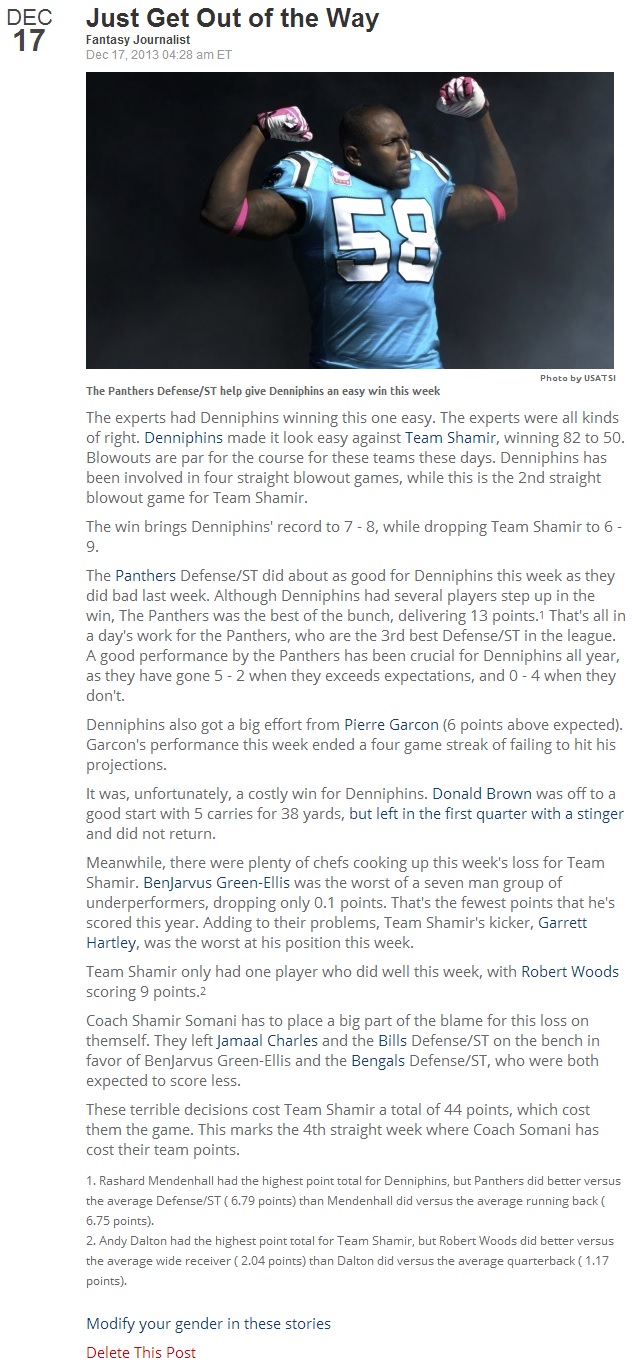
FF Auto-created article example

Check out the Blog Post: Driving Developer Adoption

Brad Genereaux, co-chair of DICOM Working Group 27, posts on how to drive developer adoption.

Definitely worth a read (be sure to follow him if you work in healthcare IT).

Article – Privacy guru knocks patient ID as ploy

I posted some thoughts recently about an article on impact of privacy on patient record sharing.

Now, here is an article that discusses the merits of giving the patient control over how they are identified and how their records should be shared.

Fundamental to this are the two approaches:

  • A formal managed infrastructure that provides (cross-)identification and record transport services (like eHealth Exchange, formerly NwHIN), or;
  • An ad hoc one that allows participants to send record information from point-to-point (ala the DIRECT or Blue Button Plus projects).

Some thoughts…

  • As I discussed with a respected colleague of mine at the recent ACR Informatics Summit, I believe that new standards like the emerging DICOMweb (aka QIDO-RS, WADO-RS, STOW-RS) and HL7 FHIR will more easily enable ad hoc exchange of records, but the role of more formal application infrastructures, like those defined by IHE XDS (and its domain specific variants, like XDS-I) will still be used where a mandate for managed patient records across a consortium exists (such as in Canada with the Canada Health Infoway).
  • As I mentioned in my prior post, society may have different motivations than those paying for the infrastructure and tools. This article attempts to express some of the concerns consumers may have about how their data is handled, which contrasts with the prior article’s statements about how “nobody under 30 cares about privacy”.

Imaging 3.0 at ACR Annual Imaging Informatics Summit

Quote: “If you don’t like change, you are going to like irrelevance even less.”

Dr. Bibb Allen talking about the importance of accepting change to the practice of Radiology, explained the rationale behind the American College of Radiology’s Imaging 3.0 framework.

Imaging 3.0 - Dr. Bibb Allen