Article – FCC, FDA, ONC seek input on mHealth regs

I find the topic of this article interesting.

Here’s why…

  • We have had notebooks and netbooks on WiFi accessing Web-based and other types of applications deemed medical devices (e.g. PACS) for years. The essential difference between a tablet and a netbook is the keyboard. They pose the same risk as a client application platform.
  • If this is what regulators are worried about, wait til they get a load of the bigger billy goat coming across the bridge next …mobile apps are one thing, but what about a portal framework that aggregates patient data from distributed sources, in real-time? Imagine a screen where each discrete element of the patient record is managed in a different system. The values used to define and indicate normal and abnormal test results are from a public Web site. Where does the “medical device” start and end? Who is the “manufacturer” responsible if an issue arises? How do you manage the medical device labeling? With mobile, we are simply trying to figure out how to do what, in many cases, we do today, only now without a wire. …regulatory affairs folks are in for a world of change (or healthcare will fall ever farther behind the IT curve).

Article – Beware: The top 4 hurdles to a successful EHR implementation

Check out this article. Some fairly common observations for an IT veteran, but good advice for EHR buyers.

Some mitigation tips for each point (read the article for the 4 hurdles)…

  1. Build in resiliency. Evaluate options to operate using locally cached data , if supported.
  2. Learn ITIL, and follow the prescribed best practices. If you do, you won’t be putting in upgrades without putting it through a test plan on a test system before moving to production.
  3. If the EMR allows customization of “templates” (or forms), they need to be validated with the representative user communities before imposing them. Some structure, and form element input validation, is needed to ensure completeness and quality of records.
  4. The application and system performance needs to be considered in the overall plan. Inventorying and analyzing transaction and interaction types and volumes, and working with the vendor to spec a system that meets the need, if an important but often overlooked step. Also, assessing the EMR for ease of scalability prior to purchase is recommended.

In regards to the comments on the trade off of lost productivity vs. potential new revenue, check out this post from a month ago.

The rise of the mobile-only user …and how this helps the underpriviliged

A friend shared this article from HBR on the rise of people that use their phone as their primary method of accessing the Internet.

When I read about these users, I envision a Starbuck’s-carrying, iPhone-toting mover-and-shaker on the way to a spin class, but there are other parts of the world that are mobile-only by necessity and not by choice.

A good (and very talented) friend of mine courageously left the corporate world to dedicate his time to TulaSalud, an organization that helps healthcare workers in rural Guatamala provide better care. If you speak Spanish, check this site out too.

The only IT platform available to the users are cell phones. Note that I said cell phones, not smart phones (at least today). And network connectivity is not always available. Want to test your mettle as a developer? Try delivering solutions in this environment.

The more mobile-first solutions are available, the faster care can be improved in the areas of the world that need it most, so this trend can only be good.

They are getting some amazing results (lots of folks talk about better outcomes; these folks are getting them) and are an inspiration of mine. I’m sure if you would like to help, they would love to hear from you.

Quebec EHR …the difference 2 years makes

The news from today (May 2013) “Quebec to expand $1.6 billion EHR“. And, from 24 months ago (May 2011), “Quebec’s EHR late and over budget, AG says“.

One thing is for sure: implementing an EHR of that size and scale (with public funds), is not for the faint of heart.

Healthcare reform inspires innovators

A friend forwarded this article on to me. It is great to see the energy being put into innovation in healthcare IT—it certainly needs it.

I have attended a few talks on the challenges facing start-ups when entering the realm of healthcare applications. Not only is healthcare a complex domain, with established vendors too often hoarding data in closed systems, but the whole issue of potentially having to becoming a registered medical device manufacturer can be daunting. I am hoping that some entrepreneurs with experience in regulatory affairs and quality system management emerge to provide affordable consulting services to start-ups. Full-time regulatory staff are often expensive and bureaucratic.

I have a written a couple of papers on innovation in different sized companies and environments. They will be published in the next few months. Stay tuned.

More from Apps for Health 2013

As I mentioned last week, there was some valuable info shared at the Apps for Health event at Mohawk college in Hamilton.

The keynote speaker, William Falk (@willfalk), shared some valuable statistics, along with a proposal for how to envision different types of apps, using a pharmacy dispensing different types of drugs, as a metaphor.

He has also shared his slides, which are well worth a look. Enjoy.

Article – Readers Write: 256 Shades of Grey(scale): The Dirty Little Secrets of Radiology and PACS

Contrary to what the title suggests, this article debates whether radiology has succeeded in solving the problem of going digital (by using PACS).

I believe that PACS solved the initial problem that it was intended to solve: get rid of film. Whether it provided more value than that had a lot to do with the design of the PACS, and who was managing it.

But, the value of PACS has a lot more to do with how it is deployed, configured and managed. If a PACS owner fails to use informatics and operational best practices, they and their users will suffer. If they fail to invest in and manage the infrastructure—such as the networks, servers, and storage—they will suffer.

I have seen too many PACS operators with too heavy of a dependence on their PACS vendor. Radiology and IT too often lack staff that understand informatics, integration best practices (e.g. as defined by IHE), or how their system operates. I have seen two hospitals with the same software application doing very similar exam volumes, and one experienced high levels of user satisfaction and operational excellence, while the other had chronic issues.

I would argue that in today’s mature PACS market, it is not what you buy, but how you use it. Provider staff need skills and knowledge about best practices. They need to know more about PACS in general, and be less constrained to knowing only what their PACS vendor tells them. And one of the best places to develop these skills and broad knowledge is SIIM.

I’ll be at the SIIM meeting—stop and say ‘hi’ if you see me.

Apps for Health – Tips for Building an App, Key Trends in Health IT

Prezi presention from @azbib (Heart and Stroke foundation) from today’s Apps for Health event.

Product developers, have a read: 10 great, practical tips on approaching app development that applies to mobile and traditional application products.

Also, some key trends in health for 2013 (originally from Forbes).

Apps for Health 2013 at Mohawk College

Mohawk1

I had heard good things about this one-day conference, so I decided to take the drive down to Hamilton, ON to check it out. I am glad I did.

Apps for Health has 3 tracks. One focused on Technology, one on Health, and another on Education. They also had keynote speakers to open and close the day of sessions.

To be honest, I was fearing that the recurring trend was going to go something like this: “Healthcare is broken! I love the App Store! Why can’t we get more apps faster!?!” …but the speakers were polished and came with insight and data.

Topics ranged from the needs for a “prescription” for a set of apps for different patient conditions, different levels of safety and risk that apps represent (for physicians and patients), regulatory challenges, privacy, security, and development approaches.

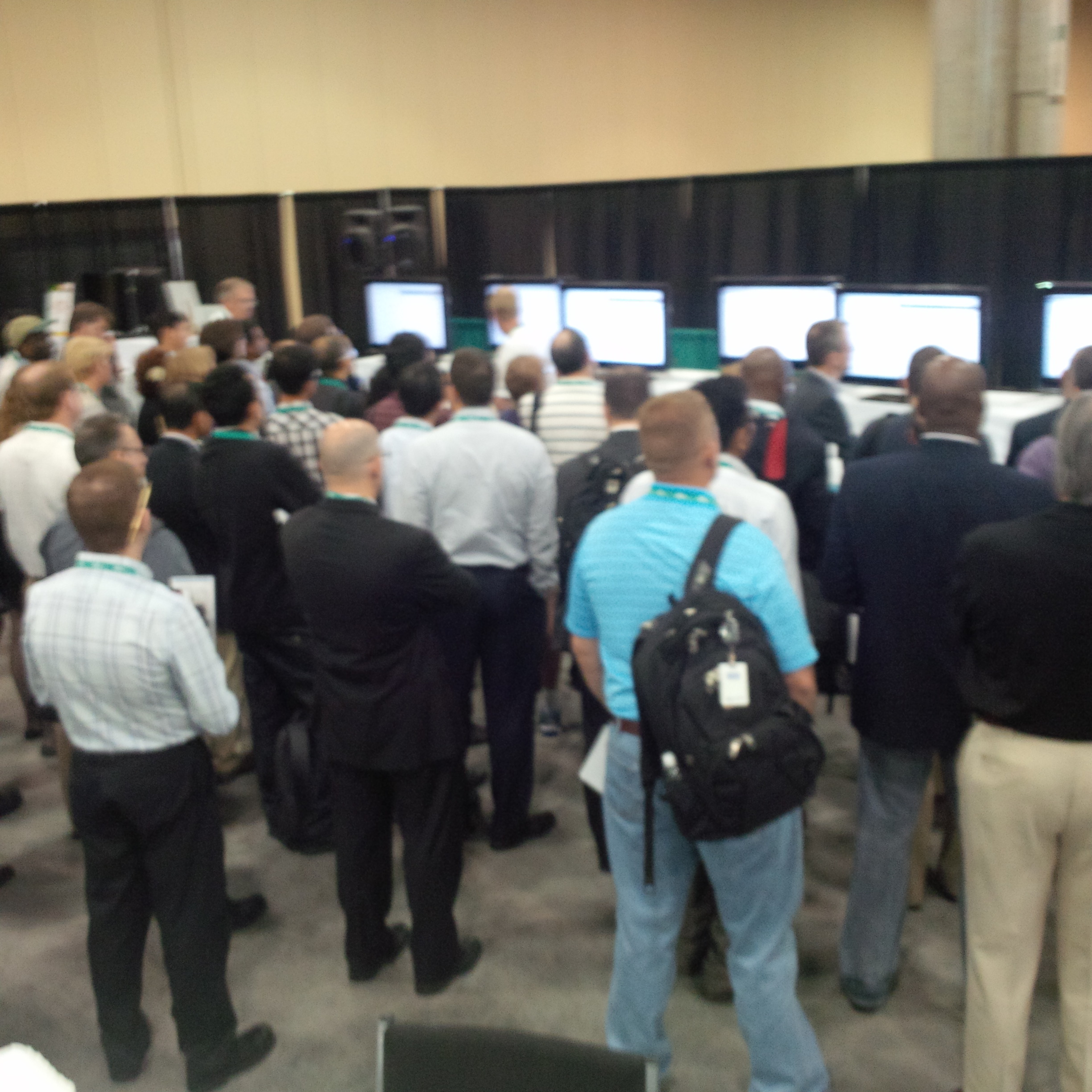
A collection of small and not-so-small vendors had table top displays set up, and attendees (and students) seemed to be routinely interacting with the vendor staff.

Having never been to Mohawk college before, I have to admit that I was quite impressed with the facilities. The buildings are very modern. Everywhere you look, you see technology—on the walls, in the classrooms, in the library, in the hands of the students …everywhere.

One of the more enjoyable parts of my excursion to The Hammer (nickname for Hamilton), was a tour of the Mohawk MEDIC lab. The students demonstrated a complete workflow of a patient’s journey through a referral from her family doctor, to an exam with a specialist (an allergist), and an unfortunate skiing accident in a remote area.

They showed how an EMR—in this case, the open source OSCAR EMR—could accept the referral and share it with the specialist by using an IHE XDS infrastructure. They then showed how the specialist could perform the exam and share the results back to the EMR using the same methods. They also showed the use of mobile technology by EMT and ER staff to review the patient’s records before administering treatment, thus avoiding a potential adverse incident (the allergist report found her allergic to penicillin and other drugs).

Mohawk is serving its students well. They are not only learning about the real world challenges facing healthcare, they are learning about how to build and apply open solutions, and use the latest tools to do it. And they are doing it in a fantastic facility. If you know someone thinking of going there, at least go for the tour—you won’t regret it.

Infographic – Healthcare Providers and Health Information Technology

A picture is worth a 1,000 words …or about US$19 billion, in this case.

Check out this USA Today-style (or theonion.com, if you prefer) infographic from the ONC.

Here is some fun with numbers….

A couple of months ago, I posted on a survey on doctors’ satisfaction with their EHR. An excerpt from the article about the survey…

“In 2012, about one-third were “very dissatisfied” with the ability of their EHR to decrease workloads, up from only one-fifth in 2010, according to the survey. Gripes were seen elsewhere, too. Thirty-two percent were dissatisfied with EHR features and functionality in 2012, compared with 20 percent in 2010, while 37 percent in 2012 were not pleased with their product’s ease of use, up from 23 percent in 2010.”

In the infographic, the ONC claims that “85% of physicians who have adopted an EHR system reported SATISFACTION with their system” (47% “somewhat”, and 38% “very” satisfied).

So, somewhere between 15% (ONC’s numbers) and about 33% (survey’s findings) is about right, I guess.

The survey and the ONC did agree on one area…

  • ONC: “8 in 10 of physicians reported that EHR use enhanced overall patient care”
  • Survey: “One-fifth were also highly displeased with the technology’s ability to improve patient care last year, compared with one-tenth in 2010″

Don’t get me wrong: I believe in the value of an EHR. I just bet that those using them 10 years from now wish that they could send us a message about what ended up really mattering.