What can Enterprise Imaging Learn from Radiology?

Radiology Information Interoperability for Productivity and Quality

In the early days of Radiology, data entry errors by Radiology Technologists (aka Techs) were common. Their attention was on the patient and the operation of the modality, not the clerical task of typing in data, after all. To address this, something called a DICOM Modality Worklist (aka DMWL) was developed and adopted.

Essentially, this took the textual patient and imaging procedure order information entered into the HIS or RIS (i.e. the order placer), and sent it to some system as an HL7 ORM message (an order). The structured patient/order information was then provided to modalities using the DICOM protocol (because this is the language they speak). DMWL could be provided by the RIS or PACS or some form of broker system that spoke both HL7 and DICOM.

This allowed trained clerical workers (or physicians), combined with software that validated the data entered (where it could), to pass the information to the modality workstation where it could be mapped into DICOM objects, without having to ask Techs to enter this info. The productivity and information quality gains were significant.

It is worth noting that the order provides other value than just eliminating duplicate data entry. It represents a work instruction, and it is used in scheduling and billing. Where image acquisition is not scheduled or billed for, orders are typically not created.

Enter Enterprise Imaging

As we enter the era of Enterprise Imaging, there are lots of lessons that we can learn from the solved problems in areas like Radiology.

For example, when capturing a photo in a Wound Care clinic, it has to be associated with the correct patient (obviously), but there is likely other pertinent info that should be captured, such as the anatomical region imaged and any observations by the physician.

In Enterprise Imaging, orders are often not placed. In many areas, the imaging is often not the primary task, but one that used to support clinical work.

If orders are not placed, how can we at least provide the benefit of passing textual patient data to the image capture device or application to reliably associate patient (and perhaps encounter or procedure) data?

Even if orders are placed, most of the devices and applications used in Enterprise Imaging cannot accept an HL7 message and do not speak DICOM. Some form of broker would likely be required yet again.

Enterprise Information Interoperability for Enterprise Image Capture

One hope that we have is the adoption of the new HL7 FHIR standard. Based on REST-based API design methods, it is much easier to integrate with different devices (especially mobile devices) than HL7 v2.x messaging and DICOM interfaces are. Other methods used are to generate a URL from the EMR, with all the info provided in parameters, that launches the image capture application/device in context. Another method is to use HL7 messaging to populate the VNA database with patient, encounter and order/procedure information (essentially a copy of what the EMR has), and use a tool or API (perhaps the DICOMweb™ Query API, QIDO-RS) to query this system to get the necessary information.

Don’t Forget the Metadata and Supporting Information

This still leaves the issue of how to reliably and consistently capture the information that goes with the image(s)—notes, anatomy info, findings, technical exam info, observations, etc. In DICOM, when this type of information is needed, a SOP Class is defined. The header of the SOP Class object specifies where all this metadata should go. This is one of the primary principles of interoperability: a defined format and data scheme, with a clear and shared meaning.

Assuming that not all Enterprise Images will be generated in, or converted into, DICOM format, the definition of the metadata schema may be left to be defined by the implementing vendor.

In addition to the clinical and technical data, sooner or later, someone is going to be looking for operational data for use in analytics and process improvement, so it will need to be captured (on some level of detail), as well.

Consistent Terms

And, even when we have a common schema, if the terms used within the scheme are not consistent, we end up spending an enormous amount of time doing mappings or integrating terminology services (and even then, never fully addressing all cases).

To Acquire or Not to Acquire

If we think about Enterprise Imaging that is not “ordered”, what triggers the acquisition of an Enterprise Image? Is it up to the clinic or individual care provider to make the judgement? Should a published set of best practices define this? Would the EMR have logic, based on the patient’s condition or care pathway, to prompt or force the user to acquire and store the image(s)?

Enterprise Imaging Acquisition Protocols Needed?

If we consider the different ways that images can be captured (still, video), the subject in frame (cropping, zooming), lighting, etc., and the ability to capture a single image or a set of images, do we also need some form of a book of protocols to guide the person acquiring the images? Should certain images contain a ruler (or object of known size) to allow the image to be calibrated for measurements?

The Cost of Doing Nothing

If we consider the impact of not having methods to avoid data entry errors, or not having a common schema, not having common terms, and not even having a common communication protocol or best practices for acquisition workflows, what hope does Enterprise Imaging have?

Even with options for all these things, imaging and information devices are still struggling to be interoperable with departmental and enterprise applications, as described in this Healthcare IT News article, “Nurses blame interoperability woes for medical errors”.

The Future is Now(ish)

This is why the mission and output of the joint HIMSS-SIIM Enterprise Imaging workgroup (charter in PDF here) is so important. The space needs to be better defined, with acquisition workflow practices, data formats, schemas, terms, and protocols outlined.

If we simply try to copy what is done in Radiology into Enterprise Imaging, it will create too much of a burden on the people asked to capture these images, and they won’t do it, frankly. Unlike the reimbursement in Radiology, they often have little incentive to spend the extra time to capture, index and upload images to the EMR when they are focused on the patient.

But, if we ignore the benefits that come with the controls and methods we have developed and matured over the years in Radiology, we risk having to re-learn all the same lessons again. And that would be very sad (and expensive, and wasteful, and unsafe…).

Add on top of all this the increasing need to share this data across different enterprises for continuity of care and the importance of interoperable data portability/liquidity is critical.

The fundamental healthcare informatics knowledge and business analysis skills developed by imaging informatics professionals, through on-the-job experience and membership in educational/research societies like SIIM, will be important in determining the right mix of proven concepts that apply, and new methods and innovations. Without a supply of talent to foster the change, nothing will change.

In Conclusion…

When dealing with such an undefined space, people often relish the idea of “doing it right this time”. I would urge anyone involved in this space to reflect on what has been accomplished in mature fields like Radiology, as there are a lot of “right things” that we may be taking for granted. With a little modernization, we can still get continued value out of what we have already achieved.
Article – Insurers will have to change to survive

I have been very interested in the changes to how Radiology revenues will be affected during the shift from volume to value based reimbursement, along with changes to healthcare business models in general. I blogged about it here.

I have also been interested in how Radiology will have to change their behaviors in this new environment of transparency and empowered consumers. I blogged about that here.

In this article, a healthcare investment firm details how insurers will have to change in order to compete for mind share among consumers (with choice).

Another very interesting point they make is about wearables. I agree that they are only used by so called Innovators (from the Innovation Adoption Lifecycle model) today.

But what if insurance companies start offering incentives in the form of reduced policy premiums for people that use them (and share the data with the insurer perhaps). This is much like having a security system on your home lowers the cost of your theft insurance, or smoke detectors lowers your fire insurance premiums. This would create a boom in the mHealth sector, and would likely improve outcomes through early detection and correcting unhealthy behaviors.

I wonder: Will providers and insurers compete for who knows the patient best?

Providers have the EMR data (for encounters with their facility), and perhaps from an HIE (if they are part of one). Insurers have info from payment transactions spanning hospitals, clinics, pharmacies and others.

Where will the data from wearables go? If the insurers are buying (by lowering premiums), I will bet that they get it more often that the provider.

Will wearables and mHealth device vendors be savvy enough to provide it to both? Will consumer-controlled PHR vendors (or information aggregation and brokering tools) have an optimized method for getting data from all a patient’s devices and apps into EMR systems? Will the provider’s EMR or HIE be open enough to receive and store the wearable’s data without manual data entry (or copy-paste)?

Will patient’s be willing to share this personal info with providers and insurers? I will bet: yes.

If I thought the data would help my outcome, and I trusted my provider, I would share it.

If it was certain to lower my premiums, I would share the info with my insurer. If the insurer reserved the right to increase premiums based on info that my wearable provided (i.e. if I sit on the couch too long, my payment goes up), I might reconsider.

Will providers supply no cost (or subsidized) wearable and mHealth devices (or apps) to patients? Will insurers and providers share this cost?

So, how can wearables help in Radiology? Other than sending out reminders on where and when to show up for the exam, and what to do (e.g. eating, etc.) prior to the procedure.

Enterprise Imaging – New HIMSS-SIIM Workgroup

The discussion of so called Enterprise Imaging is a hot topic. So I was very excited to read about the newly announced joint workgroup between HIMSS and SIIM. I believe it holds a lot of promise.

In my experience, there is no lack of technical solutions for capturing, managing, discovering, accessing and viewing enterprise images and related information. The challenge is discovering and sharing the knowledge on best practices of how to put it all together and how to operate the systems that manage this information.

Like diagnostic imaging exams, enterprise images are part of the patient’s medical record, so understanding how they should best be incorporated into the EMR is very important. And this is not just a technical discussion, there are lots of issues around policies and governance of the data that organizations—not their vendors—have to get a handle on.

This is why this workgroup is so important. HIMSS knows all about EMR solutions, and SIIM knows imaging informatics. A perfect marriage.

Article – SIIM: Experiment in web technologies points to future of health IT

Here is an article summarizing the way Cleveland Clinic is using REST-based APIs to solve real problems in their institution. Taken from a talk given by Mat Coolidge at the SIIM 2014 Annual Meeting.

Article – CDC on EHR errors: Enough’s enough

In this article, the CDC has issued a warning on the issues of user interface design when presenting patient information in EHRs.

As the examples in the article illustrate, having information in digital form is not enough. It needs to be presented in an effective way to ensure comprehension. After the current wave of information digitization and consolidation (moving information from disparate, departmental clinical information systems into a single large enterprise system), the next wave of effort needs to be on privacy/security, accessibility/reliability, and usability, or the incredibly high potential gains will not be realized.

Users need to trust the system, it needs to be there when they need it (wherever that is), and they have to want to use it.

P.S. Here is an infographic on EHR adoption.

The Value of Hackathons in Healthcare

Having participated in the inaugural SIIM 2014 Hackathon, I can appreciate the diverse expectations that participants have. Some think of these events as a way to learn and experiment, others a competition. Some prefer to work as a team, others alone. Some are interested in integrating existing systems and data in new ways, while others want to invent something completely new.

In any case, I found this article insightful. It explores why the concept of “hacking” is so prevalent in healthcare, and also touches on why new “apps” often struggle to make it past the hackathon stage. It even posits that a hackathon can replace the traditional RFP procurement process for identifying and selecting innovative solutions.

Revenue Revolution in Radiology

I have been reading a lot recently about trends in healthcare and imaging around costs and revenues. There seems to be a perfect storm of changes in the market that will have a fundamental impact on diagnostic imaging service providers. I find this topic interesting because, unless you understand how the money is moving, you won’t understand why things are happening. Here is a summary of what I have discovered.

Medicare Reimbursement Cuts

This one is obvious. If you lower the amount of money paid for something, your revenues will go down (unless volume goes up proportionally). Here is an infographic from MITA on the cuts made since 2006.

Fewer Medical Imaging Exams being Ordered

Here is an article from MITA on the decline of the total number of CT exams being done in the U.S. Here is another one citing data published by the American College of Radiology (ACR). It states: “…physicians are calling for less, not more, imaging tests.” This shows a measurable reduction in the volume of exams performed in the U.S. And here is an article indicating a steady decrease in imaging studies being ordered for patients in the ED, following a steady increase up to 2007.

Image Sharing

The sharing of patients’ clinical records across facilities is a key part of Accountable Care, and is generally a good thing for patient care. So is sharing imaging records. With reliable options now available on the market, sites within a local referral area are rapidly launching or signing up to services to share images. The clinical benefits of comparing new imaging exams with priors are well understood, but this practice will often result in avoiding the need to perform a repeat exam. This benefits the patient (less radiation and anxiety and delay), and the operations of the receiving organization (less schedule disruption, less costs due to CD importation). The other impact, of course, is that the receiving organization loses some revenue from that avoided repeat exam. This will result in a reduction in volume of exams performed.

Adoption of Clinical Decision Support

Starting on January 1, 2017, imaging exams will require the use of Clinical Decision Support (CDS) to ensure that physicians are following Appropriate Use Criteria (AUC). In addition to clinical evidence, factors such as relative radiation level and cost of the exam are used to determine what is appropriate. All things being equal, the lower cost exam is likely to be recommended. The adoption of CDS may result in a reduction in volume of exams performed, or a recommendation to a lower cost (profit) exam.

Preauthorization Requirements

In some insurance plans, preauthorization is required before certain exam types can be ordered (even when CDS is used, in some cases). This may require a consultation with a radiologist or Radiology Benefits Management (RBM) company. Here is an article from 2011 on the use of preauthorization and CDS. The larger the burden on the ordering physician, the less likely they are to order the exam, which may result in a reduction in volume of exams performed, or a recommendation to a lower cost (profit) exam.

Patient Steerage

Last year, I did a blog post on an article on the trend of “patient steerage”. The original article is here. Essentially, patient steerage is when a payer incents a patient to use a provider that offers the imaging service at a lower cost. If a service provider is not price competitive, this will result in a reduction in volume of exams performed.

The Castlight Effect

This company received a lot of attention because of the size of its IPO, but it is also notable for what they actually do. As this article explains, they provide healthcare provider cost information for a range of healthcare services to employee health plans. The intent being that, given the choice, consumers will choose lower cost options. This is very likely to happen when the patient has a significant co-pay (e.g. 20%) and they will personally benefit from lower cost options. If a service provider is not price competitive, this will result in a reduction in volume of exams performed.

Wait, but what about Quality?

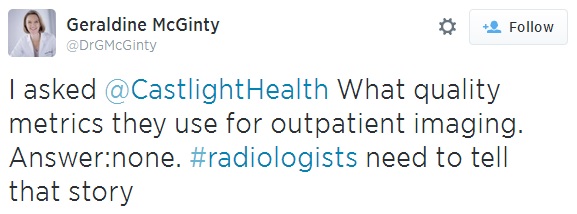
With all the talk about the shift of reimbursement from volume of procedures to quality or outcomes, I found this tweet on Castlight interesting… Castlight Tweet If we shift away from volume incentives/payment, reduce the prices paid (through policy or competition), but don’t recognize quality, the service of diagnostic imaging has been commoditized, and I don’t think that this will benefit patients, in the end.

Consolidation

I have heard a couple of opinions that believe that the strong trend of consolidation among healthcare providers will allow the largest of providers to dictate terms and pricing to payers. As it was explained to me, it works like this: The big, well-known healthcare provider, which has bought up many of the facilities in the area, tells the insurance payers, ‘If you don’t give me preferential pricing for my services, I won’t accept your insurance plan at my facilities’. If the healthcare provider is big enough and well respected, the insurance provider will have a tough time selling insurance plans to companies and individuals when the buyer learns that they can’t go to the big provider. This is called leverage. If this is true (and I think that it is), this will result in isolated areas of reimbursement stabilization or even increases. Here is an article talking about what the impact of provider consolidation means to private payers. It cites a steady increase in the number of physicians becoming employees of hospitals (vs. independent private practices)…

“…the number of doctors employed by hospitals increased to over 120,000 from 80,000 between 2003 and 2011. About 13 percent of all doctors are now employed directly by hospitals.”

A Necessary Change in Revenue Cycle Management Systems

Here is an article on the need for an overhaul of Revenue Cycle Management (RCM) systems in the U.S. It includes some stats on administration costs per transaction (compared to financial services transactions) and consolidation trends, as well as the value of analytics. Some excerpts…

“…the number of hospitals per integrated delivery system took a big jump last year from 6.4 to 7.1…”

“…the physicians who go into practice do not want to be entrepreneurs as much as they used to. When 52 or 53 percent of residents today become employees of integrated delivery systems, it tells you that the whole market has changed.”

Using Analytics to Maximize Revenues

Here is an article on using analytics and their reports to optimize financial operations.

So, what do you think?

P.S. Here is an interview that goes into the details of payer vs. provider, along with a case for more bundled payments. And here is a blog post that goes into more detail on bundled payments, including the shift from retrospective to prospective bundles.

P.P.S. Here is an article explaining the difference between charges and costs.

P.P.P.S. Here is a notice of rule changes proposed by CMS on the method by how physicians fees will be determined. “…we are updating our practice expense inputs for x-ray services to reflect that x-rays are currently done digitally rather than with analog film.”

P.P.P.P.S. Here is an article on a study on the disparity of costs for a Mammogram in the L.A. area. $60 to $254 for self-pay, with a bill of $694 to the insurance company for the same procedure elsewhere. 30% of Mammograms in the study were self-pay.

P.P.P.P.P.S Here is an article, with a nice infographic, on 5 common medical practice denials and remedies. Spoiler alert: Radiology made the Top 5 list of unexpected denials.

P.P.P.P.P.P.S Here is an infographic on the declining employment demand and income of Radiologists by a medical recruitment firm.

Video – Interview on SIIM Hackathon

Here is a short video interview I did about the SIIM Hackathon. Clearly, I am not quite ready to go into broadcasting. 🙂

Healthcare Informatics 100 – Gold Rush for Health IT Vendors

The latest edition of the top 100 healthcare IT vendors, by revenue, has been released. This article provides some insight, and here is the actual list.

For some perspective, here is a blog post from the Editor-In-Chief of Healthcare Informatics, Mark Hagland, that includes and analysis of the list and some trends over the past few years.

An excerpt: “…five years ago, the 2009 Healthcare Informatics list revealed that the vendor with the highest HIT revenues had $2.98 billion in 2008 revenues, while the 100th and last on the list had $5.1million in 2008 revenues. This year, the top company reported $3.4 billion in revenues, while the 100th largest company reported $35 million in revenues. In 2009, reporting $35 million in revenues would have put a vendor company up at number 65th on the list.”

Article – SIIM Hackathon gives DICOMweb a coming-out party

Check out this article in Radiology Business Journal on the recently concluded Hackathon at the SIIM 2014 Annual Meeting in Long Beach, California.

Here are my other observations on SIIM 2014, in case you missed it.